You're probably here because someone told you your title capitalization is wrong. Or you're a copywriter switching between style guides and the rules keep contradicting each other. Both are frustrating for the same reason: the four major style guides agree on most things and diverge on exactly the words you'd least expect.
I built this tool after working with copywriters who each had their own style guide requirements: AP for one client, Chicago for another, APA for academic work. The rules look simple until you hit a title with "from" or "to" in it, and then they're not.
Here's the complete breakdown.
The rules every style agrees on
Four things are consistent across AP, APA, Chicago, and MLA:
- Capitalize the first word of the title
- Capitalize the first word of a subtitle (the word immediately after a colon)
- Capitalize nouns, verbs, adjectives, adverbs, and pronouns
- Lowercase articles (a, an, the) unless they're the first word
These are the baseline. Every error people make is in what comes next.
Style guide comparison table
The differences cluster around prepositions, conjunctions, and a few specific words. Here's where they actually diverge:
| Word or word type | AP | APA | Chicago | MLA |
|---|---|---|---|---|
| Short prepositions ≤4 letters (in, on, at, by, of) | lowercase | lowercase | lowercase | lowercase |
| Longer prepositions 5+ letters (about, after, between, through) | Capitalize | Capitalize | lowercase | lowercase |
| Coordinating conjunctions (and, but, for, or, nor) | lowercase | lowercase | lowercase | lowercase |
| Yet and So | lowercase | lowercase | Capitalize | lowercase |
| As | lowercase | lowercase | lowercase | Capitalize |
| If | lowercase | lowercase | Capitalize | Capitalize |
| To in infinitives | Capitalize | lowercase | lowercase | lowercase |
| Last word of title | Capitalize | no specific rule | Capitalize | Capitalize |
| First word after colon | Capitalize | Capitalize | Capitalize | Capitalize |
Rather than memorizing this table, paste your title into the converter and select your style. It applies the correct rules automatically.
APA title case and the sentence case trap
APA's rule: capitalize words of four or more letters. Lowercase words of three or fewer letters (articles, short conjunctions, short prepositions). So "from" (4 letters) = capitalize. "for" (3 letters) = lowercase.
That's manageable. The part that trips people up is this: APA uses two different capitalization systems depending on where you're writing.
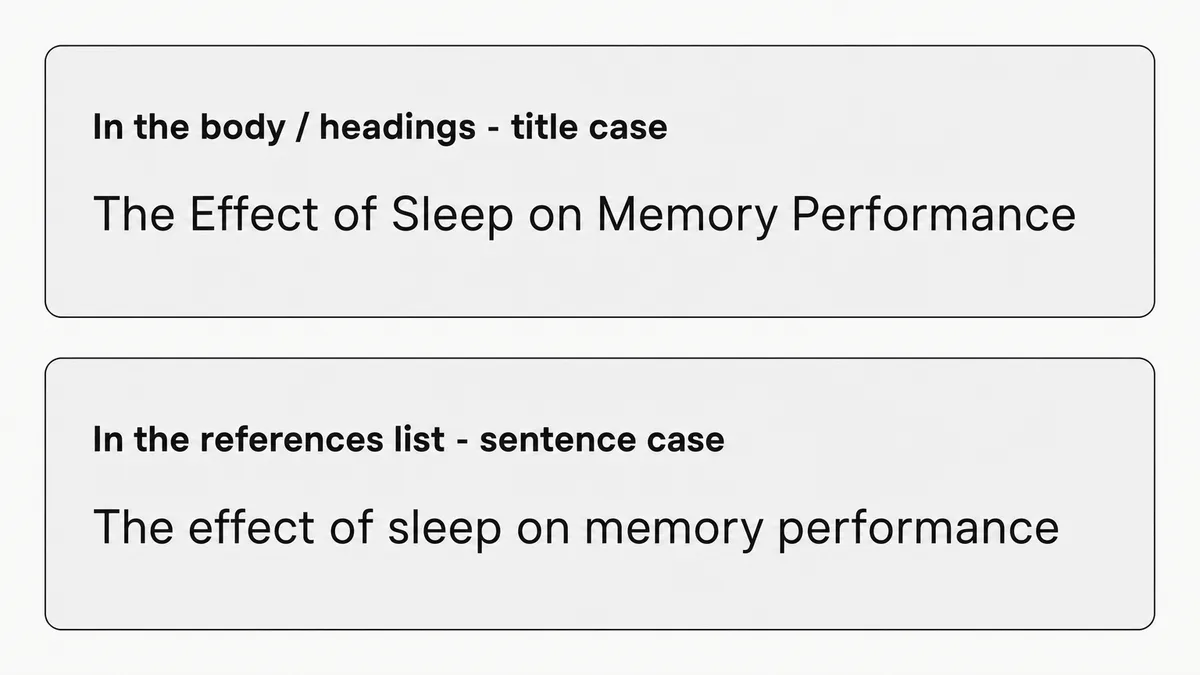
In the body of your paper (headings and when you mention a title in running text), use title case:
According to Johnson's The Effect of Sleep on Memory Performance...
In your references list at the end of the paper, use sentence case. Only capitalize the first word, proper nouns, and the first word after a colon:
Johnson, M. (2022). The effect of sleep on memory performance: A meta-analysis. Journal of Sleep Research.
Same source, two different capitalizations depending on where it appears. Students submit papers with their entire references list in title case because every other style guide uses title case in citations. In APA, that's wrong.
One more APA quirk: unlike Chicago and MLA, APA has no specific rule requiring the last word of a title to be capitalized. If a minor word falls last, it stays lowercase in APA.
AP title case: the only style that capitalizes "to"
AP (Associated Press) is used in journalism, press releases, and most online news writing. Its rule is similar to APA: capitalize words of four or more letters, including prepositions and conjunctions of that length.
The quirk that catches everyone: AP capitalizes "to" in infinitives. Every other major style guide lowercases it.
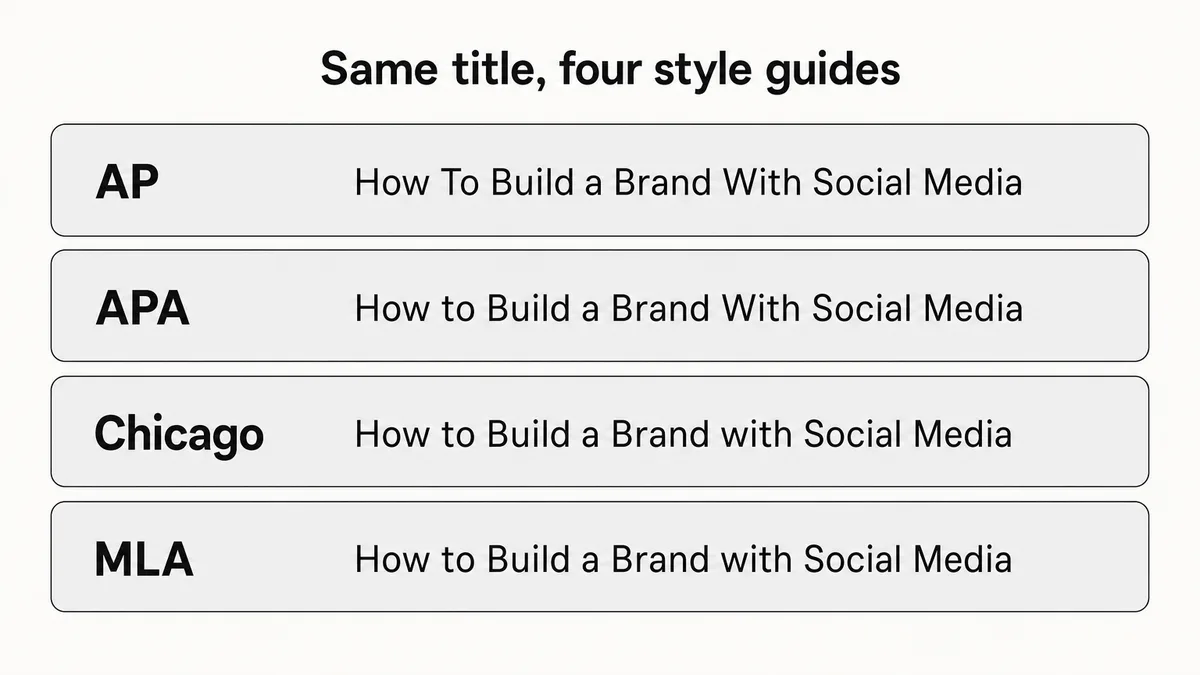
Same title in all four styles:
| Style | Result |
|---|---|
| AP | How To Build a Brand With Social Media |
| APA | How to Build a Brand With Social Media |
| Chicago | How to Build a Brand with Social Media |
| MLA | How to Build a Brand with Social Media |
Notice that "With" (4 letters) is capitalized in AP and APA but lowercase in Chicago and MLA. And "To"? Only AP capitalizes it.
If you write for a newspaper, a PR agency, or any outlet that follows the AP Stylebook, "How to" becomes "How To." Every time. It looks odd if you're not used to it, but that's AP.
Chicago title case: prepositions, however long
Chicago's approach is function-based rather than length-based: lowercase a word because of what it is, not how many letters it has. That means all prepositions are lowercase in Chicago, regardless of length.
"Between," "through," "without," "during" are four words that AP and APA would capitalize, yet all stay lowercase in Chicago.
Chicago also lowercases the five coordinating conjunctions (and, but, for, or, nor). But "yet" and "so" (technically in the FANBOYS group but frequently functioning as adverbs) are capitalized in Chicago. That distinction doesn't come up often, but when it does, "Yet" and "So" should be capitalized in a Chicago-style title.
Chicago explicitly requires capitalizing the last word of a title, whatever it is. If your title ends with "of" or "the," capitalize it: A History Of looks wrong but it's correct in Chicago.
MLA title case: the simplest system, mostly
MLA (Modern Language Association) is used in humanities: literature, film, art history, cultural studies. Its approach to prepositions matches Chicago (lowercase all of them regardless of length), but it handles subordinating conjunctions differently.
In MLA, subordinating conjunctions are capitalized. That includes if, because, although, when, since, and as when it's used as a subordinating conjunction. Other styles lowercase as in titles; MLA capitalizes it.
So "As I Lay Dying" (Faulkner's novel, which conveniently uses "as" as a subordinating conjunction) is correct in MLA. In AP, APA, and Chicago, "as" would stay lowercase.
MLA, like Chicago, capitalizes the last word of a title.
Which style applies to you
Five contexts, five answers:
Student writing a humanities essay (literature, film, art, cultural studies): MLA. Your institution's style sheet will confirm it, but MLA is the default for English departments in most universities.
Psychology, education, nursing, social sciences: APA. The 7th edition (2020) is current. Pay close attention to the sentence case rule for your references list.
History, legal writing, or anything being published as a book: Chicago. The 17th edition (2017) is current. Chicago is also the house style for many general publishers.
Journalism, press releases, news writing, blog posts for media outlets: AP. The Stylebook updates annually; the online edition is the most current.
Blog or website without a house style guide: Pick Chicago or AP and apply it consistently. Inconsistency is the only version that's clearly wrong.
The two errors that appear in almost every draft
The subtitle rule. After a colon, capitalize the first word; all four styles agree. This is the rule that gets broken most often because people treat the subtitle as a continuation of the title rather than as a fresh start.
Wrong: The Politics of Persuasion: a study of modern rhetoric
Right: The Politics of Persuasion: A Study of Modern Rhetoric
Doesn't matter if "a" would normally be lowercase. It's the first word of the subtitle, so it's capitalized.
"To" in infinitives. If you're writing in AP, "to" is capitalized. If you're writing in any other style, it's not. This error runs in both directions: AP writers who lowercase it (from habit), and non-AP writers who capitalize it (from seeing AP-style writing).
The title case converter handles both of these automatically for each style.
FAQ
What words should NOT be capitalized in title case? Articles (a, an, the), short prepositions (in, on, at, by, of, for), and coordinating conjunctions (and, but, or, nor) are lowercase in all four major styles, unless they're the first word of a title or subtitle.
Does APA use title case or sentence case? Both, depending on context. Use title case for headings in your paper and when mentioning titles in your text. Use sentence case in your references list (only the first word, proper nouns, and the first word after a colon are capitalized).
What is the difference between AP and APA title case? Both capitalize words of four or more letters. The main difference: AP capitalizes "to" in infinitives (How To Write a Title); APA lowercases it (How to Write a Title). APA also has the sentence case rule for references, which AP doesn't.
Is "from" capitalized in title case? Depends on the style. "From" is four letters: AP and APA capitalize it. Chicago and MLA lowercase all prepositions regardless of length, so "from" stays lowercase in both.
Do you capitalize the last word of a title? In Chicago and MLA: yes, always. In AP: yes. In APA: no specific rule, so if the last word would normally be lowercase, it stays lowercase.
What is the rule for titles after a colon? All four styles agree: always capitalize the first word after a colon in a title, even if it's a word that would normally be lowercase (like "a" or "the"). This applies to subtitles in papers, books, and articles.